
Geometry Dash
Recommend For You




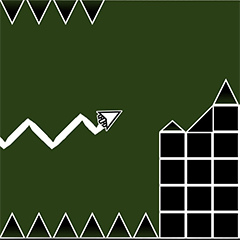
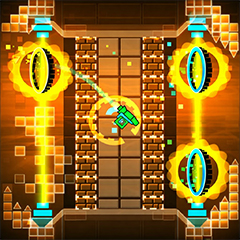



What is Geometry Dash?
Geometry Dash is a geometric role-playing game where players control shapes to overcome obstacles, combining movement, spatial logic, and music rhythm.
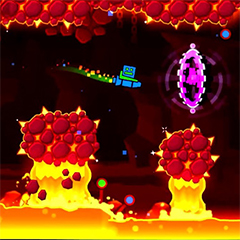
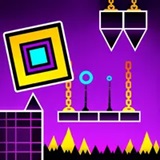
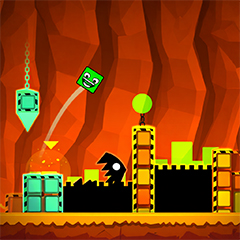
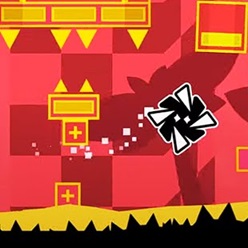
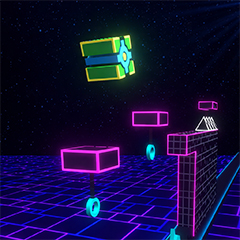
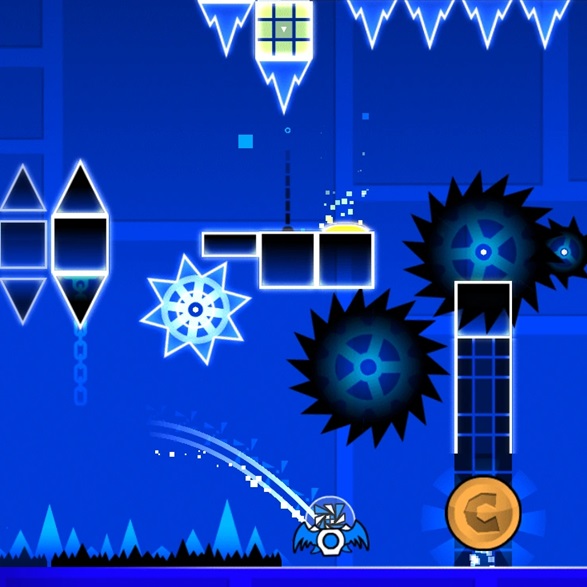
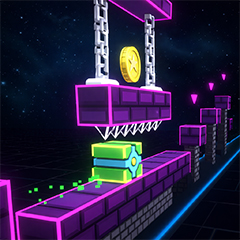
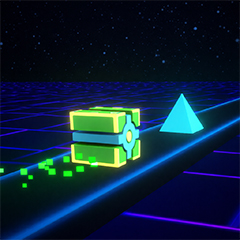
In Geometry Dash, the entire world in the game is built from geometry. The main character is a square (cube), and the surrounding environment includes roads that are rectangles, obstacles that are squares and diamond shapes, spikes that are triangles, teleport portals that are circles or ellipses, and the finish gate is usually a circle or an ellipse. All objects in the game, from the character to obstacles and effects, are simple geometric blocks, very similar to the shapes in basic geometry problems.
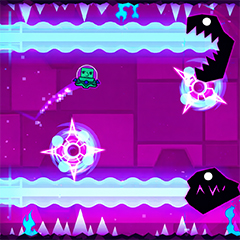
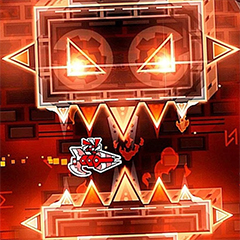
Other characters such as the robot, spaceship, UFO, ball, or wave are also not characters in the traditional sense, but are constructed from basic geometric shapes such as squares, rectangles, circles, and triangles. Although they have different names, in essence they are collections of geometric shapes combined together, transformed in size, angles, and movement to create different gameplay mechanics.
In terms of how to play, players control these geometric shapes using a single button (click, tap, or space) to slide on flat surfaces, jump over obstacles, fly in space, surf waves, reverse gravity, and change the movement axis. Simply put, Geometry Dash is a game where players control a geometric shape moving in a geometric world, passing other geometric blocks to the rhythm of music, like a moving geometry problem turned into a video game.
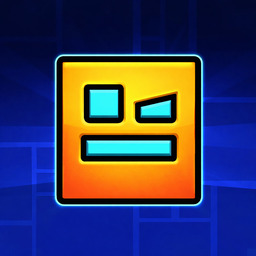
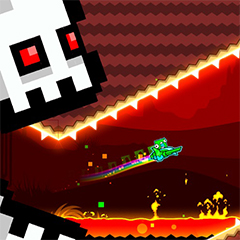
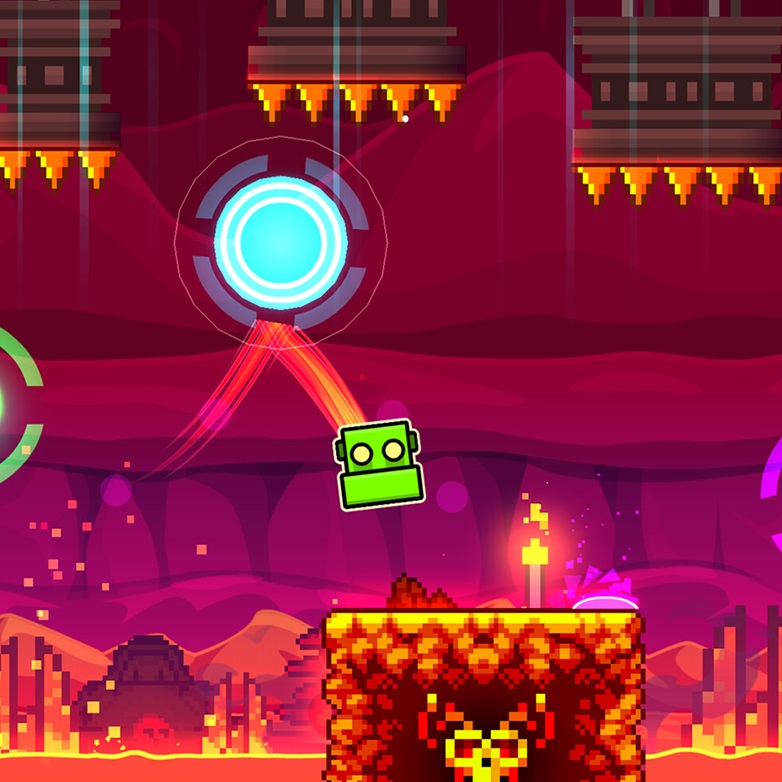
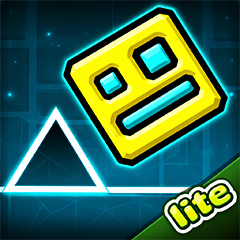
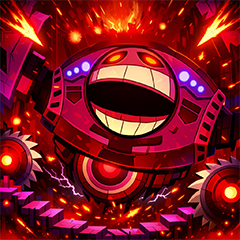
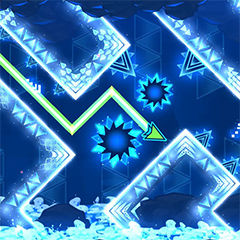
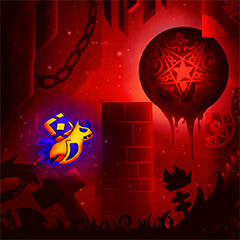
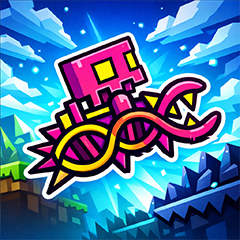
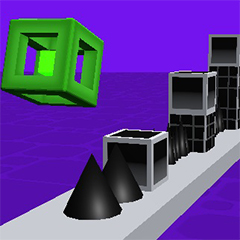
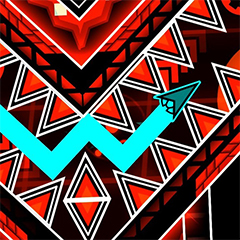
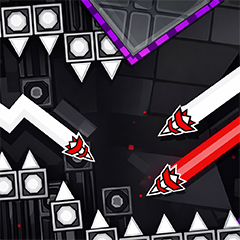
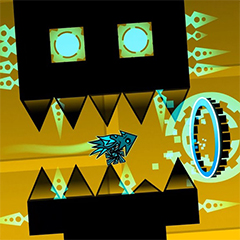
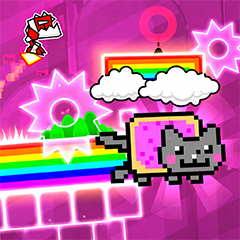
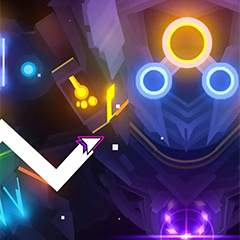
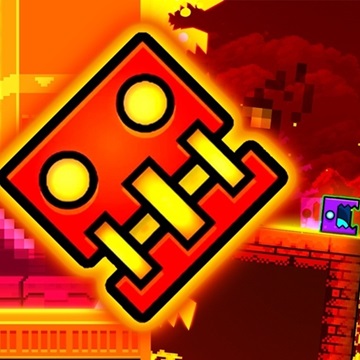
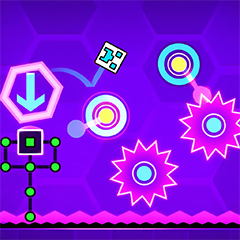
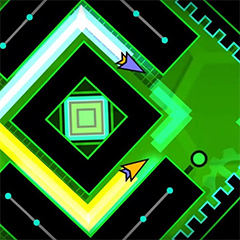
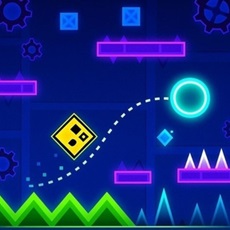
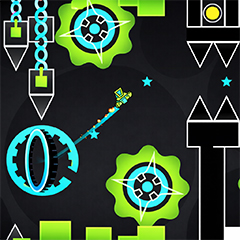
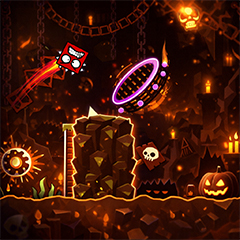
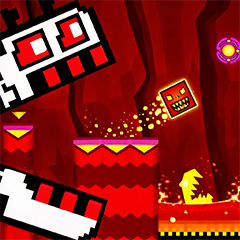
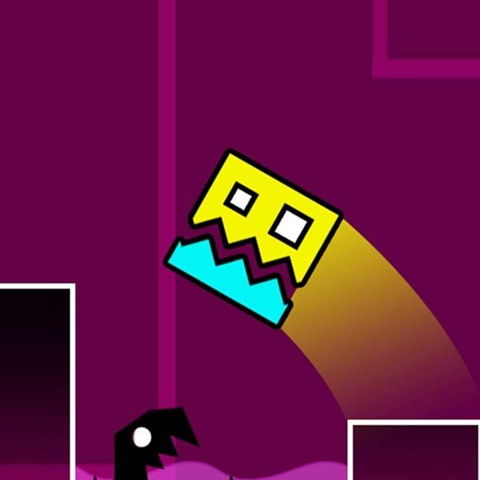
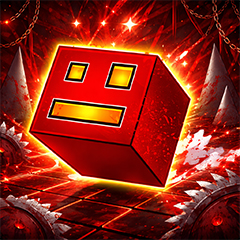
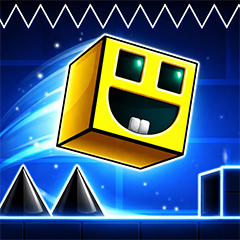
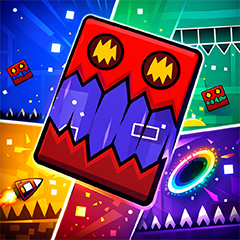
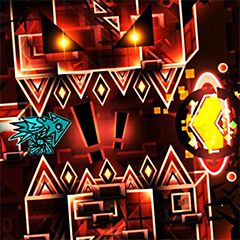
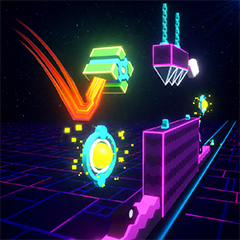
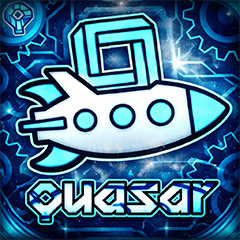
The Geometry Dash cube character on a background that combines four of the most popular levels.
How does the gameplay work?
Gameplay in Geometry Dash revolves around a one-button control mechanism, where players only need to click, tap, or press the space key to control the character to overcome obstacles ahead. Each press changes the character's movement state, depending on the geometric form being used in the level.
During gameplay, the character can switch through many different movement states, and each state corresponds to a distinct physics mechanism:
Running and jumping on flat ground: the character automatically slides forward, and each time the player taps or clicks, the square jumps up to pass the geometric blocks in the way.
Flying in space: the character no longer follows fixed gravity, and each tap reverses the flight direction, allowing it to fly upward or downward, creating the feeling of controlling a spaceship moving through a narrow space.
Rolling with gravity: the character is pulled by gravitational force, and each tap reverses the pull, causing the ball to be pulled up to the ceiling or fall down to the floor, forcing the player to calculate the movement path precisely.
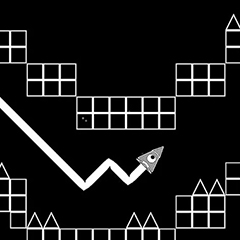
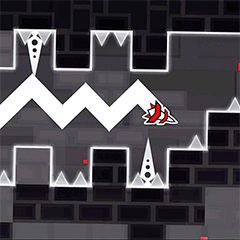
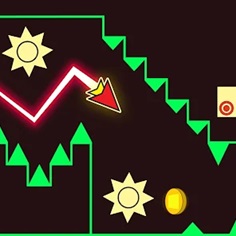
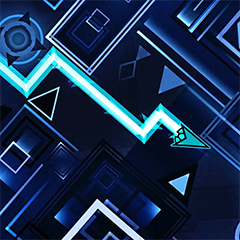
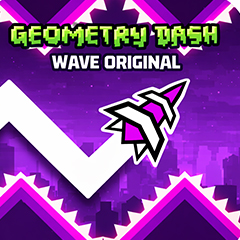
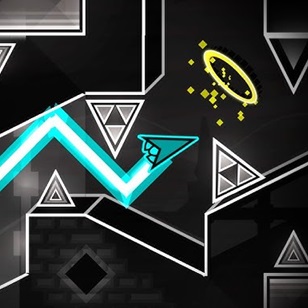
Surfing diagonally in wave form: the character moves in a wave pattern, and each tap changes the wave direction, creating continuous zigzag movement along the diagonal axis.
Reversing and changing the movement axis: the character can be flipped on an axis, the space can be rotated, or the movement direction can change, making the entire level layout feel reversed compared to the original sense of direction.
The core of the gameplay lies in musical rhythm. All obstacles, gaps, and traps are arranged to synchronize with the background music, so players must not only rely on their eyes but also listen to the beat to time inputs accurately. Just touching a square edge, a triangle, or a wall will immediately end the level and restart it from the beginning.
The gameplay of Geometry Dash can be understood as the combination of moving geometry, one-button physics mechanics, and musical rhythm as the measure of time. Each click is not only a control action, but also a beat in the music, and players must memorize the entire geometric layout of the level to pass it using reflexes and muscle memory.
What types of characters are there?
In Geometry Dash, "characters" are not characters in the traditional sense, but geometric forms with different physics mechanisms. Each form represents a different way of moving, requiring the player to change their control mindset when passing through transformation portals in the level.
The common character forms include:
Cube (square): the most basic form. The character automatically slides forward, and each tap makes it jump to pass obstacles. This is the most frequently appearing form and is also the foundation of the entire gameplay.
Ship (spaceship): the character can fly freely in space. Holding or tapping makes it fly upward, releasing makes it fall downward, similar to controlling the thrust of a ship.
Ball: the character is governed by gravity reversal. Each tap changes the direction of the pull, so the ball is pulled to the ceiling or falls to the floor.
UFO: similar to flying, but each tap is a fixed bounce, creating the feeling of jumping on beats in mid-air.
Wave: the character moves diagonally in a wave pattern, and each tap changes the wave direction, producing very fast zigzag movement and requiring high reflexes.
Robot: similar to the cube, but the player can hold the button to adjust jump height, allowing more flexible control.
Spider: each tap instantly teleports between the floor and the ceiling, like teleporting along a vertical axis.
All of these forms, although they may be called robots or spaceships, are fundamentally still basic geometric shapes combined and transformed, without biological details or complex models. Their differences are not in appearance, but in the physics rules and how they respond when the player taps the button.
This multi-form character system makes Geometry Dash not just a simple jumping game, but a sequence of consecutive geometric mechanics, where each transformation portal is like forcing the player to "learn how to move again" within the same level.
How is difficulty classified in Geometry Dash?
In Geometry Dash, the difficulty of a level is not determined by health, player level, or character stats. Instead, it is evaluated based on the complexity of the geometry, the movement speed, and the reflex demands placed on the player. The more obstacles there are, the faster the pace becomes, and the denser the transformations are, the higher the difficulty.
Difficulty in Geometry Dash is commonly classified into the following levels:
Easy: simple levels, slow speed, few traps, suitable for beginners learning the jumping mechanic and learning to follow the beat.
Normal: more types of obstacles begin to appear, requiring the player to memorize the level layout and maintain stable reflexes.
Hard: speed increases clearly, many sections require continuous transformations, demanding more precise timing.
Insane: traps are dense, many flying sections, gravity reversals, and wave sections appear in succession, and a single wrong beat leads to failure.
Demon: the highest difficulty level in the official system, requiring muscle memory, very fast reflexes, and the ability to memorize the entire geometric structure of the level.
Extreme Demon: the hardest level in the community, often user-made levels with extremely high speed, continuous transformations, and nearly zero tolerance for mistakes.
The special point is that difficulty does not increase through character levels, but increases through geometric space and rhythm. Players cannot "grind stats" to make it easier, and there is only one way to beat a hard level: play it repeatedly, memorize the layout, and train reflexes.
Therefore, difficulty in Geometry Dash is essentially: The difficulty of how well a human can keep up with geometric motion in space following the rhythm of the music.
How do you play the game?
To play Geometry Dash, players can access it directly in the browser at: https://geometry-dashpc.com
This website allows you to play immediately without installation, suitable for both computers and mobile devices.
In terms of controls, Geometry Dash uses a one-button mechanism, but the way you interact is different depending on the device:
On computer:
Left mouse click: jump, fly upward, reverse direction, change state.
Space key: works the same as left mouse click.
On phones and tablets:
Tap the screen: performs all control actions.
Each tap is equivalent to one click on a computer.
The general rule is:
Each press or tap equals one movement change.
There is no joystick, no left-right movement; the character always moves forward automatically.
Players only need to focus on:
Observing the geometric layout ahead.
Listening to the music beat.
Pressing at the correct moment to avoid hitting obstacles.
Therefore, playing Geometry Dash is not about learning many keys. It is about training reflexes, memorizing the level structure, and sensing rhythm. With only one button, the entire gameplay is built around timing and muscle memory.
What are the popular versions of Geometry Dash?
The Geometry Dash series is divided into multiple official versions. Each version keeps the same core gameplay mechanics, but differs in content scale, average difficulty, and design theme.
Below is a comparison table focused on gameplay meaning:
| Version | Has Level Editor | Has Community Levels | Average Difficulty | Main Theme |
|---|---|---|---|---|
| Geometry Dash (Full) | Yes | Yes | From Easy to Extreme Demon | Overall, full mechanics |
| Geometry Dash Lite | No | No | Easy - Normal | Basic introduction |
| Geometry Dash World | No | Yes | Normal - Hard | Online, community |
| Geometry Dash SubZero | No | No | Hard - Insane | Ice, technology |
| Geometry Dash Meltdown | No | No | Normal - Hard | Fire, energy |
How is Geometry Dash different from similar games?
Compared to games in the same genre such as Geometry Vibes, Space Waves, or Geometry Arrow, Geometry Dash stands out because of the Level Editor, which allows players to create and share levels instead of only playing pre-made content.
Geometry Dash also has no random factors. Each level is identical every time, so winning or losing depends entirely on the player's skill and ability to time inputs with the beat.
In addition, music is directly tied to gameplay, obstacles are placed according to the beat, and difficulty tiers such as Demon and Extreme Demon are rated by the community, creating a common standard that similar games usually do not have.
In short, Geometry Dash is not only a rhythm platformer game, but a geometric game platform with a content ecosystem created by players.
Conclusion
If you enjoy geometry, this game offers a natural and intuitive way to interact with geometric shapes through movement and rhythm.
With a one-button control system, gameplay depends entirely on timing, reflexes, and memory, combined with musical rhythm as the axis of time. Geometry Dash creates a style that is very different from typical action or platform games.
More importantly, thanks to the Level Editor and the player community, Geometry Dash is not limited to a fixed set of levels, but becomes an open geometric ecosystem where content continuously expands and difficulty can increase almost without limit.
Geometry Dash can be seen as:
A moving geometry problem turned into a game, where players not only play, but also learn how to read rhythm, read space, and master geometric motion in real time.